The Mediterranean Sea is becoming warmer and saltier at an accelerating rate
November 23, 2026
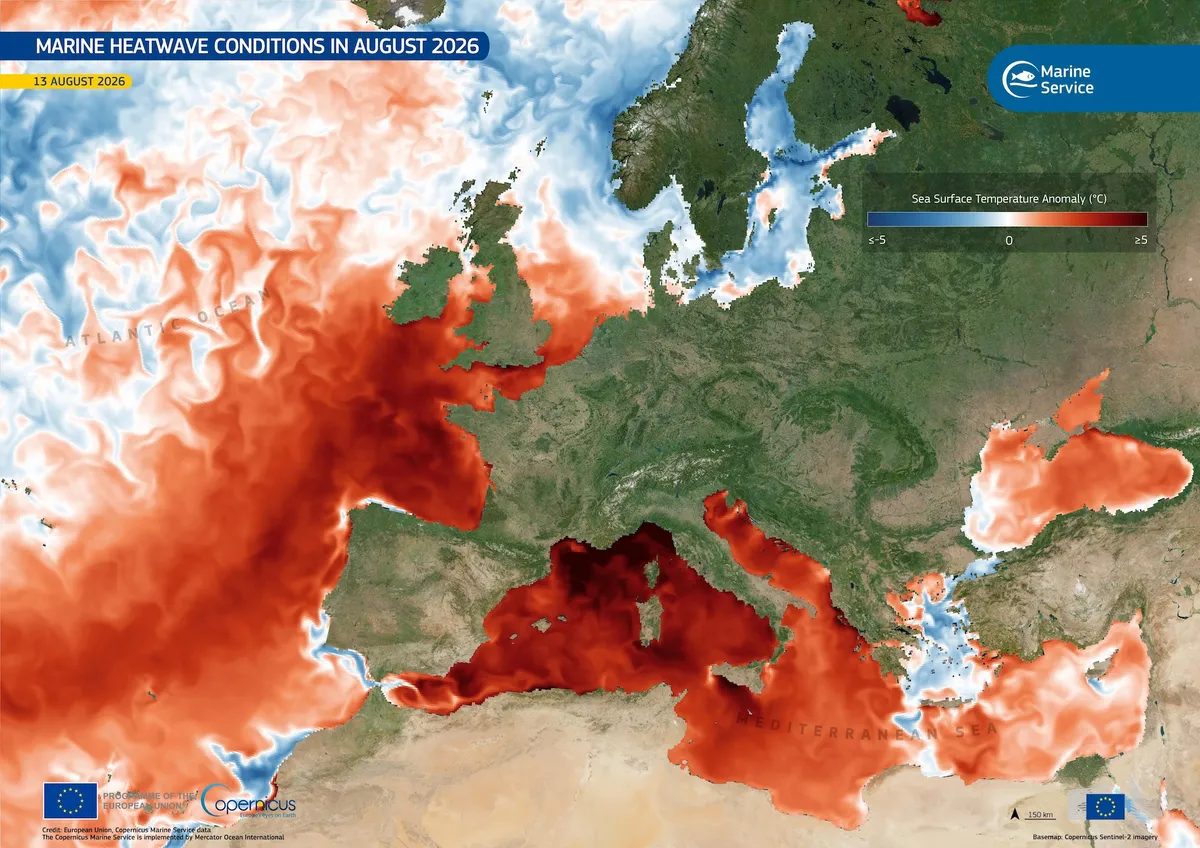
Illustration: Marine heatwave conditions in the Mediterranean Sea and the Atlantic Sea, 14 August 2026. Credit: European Union, Copernicus Marine Service Data.
Evidence is growing that oceans aren’t just changing because of climate change, they are changing ever more rapidly. The Mediterranean Sea can be used as an early indicator of these changes. The sea is a global hotspot of climate change, responds fast to global warming, and these changes are transmitted relatively fast to the deeper parts of the basin.
Natural laboratory
The basin is a natural laboratory for detecting accelerating ocean change. Previous studies have shown that warming and salinization rates in the Mediterranean Sea exceed the global ocean average.
Various datasets of in situ measurements of temperature and salinity have been combined and analysed, spanning 1950 - 2025. The compiled dataset provides basin‐wide, multi-decadal coverage across the Mediterranean Sea. The results reveal a continuous warming and salinization of the upper 2 kilometres that is, in fact, accelerating. The Mediterranean Sea is changing rapidly.
21st versus 20th century
A comparison of average water temperature and salinity this century (period 2000-2025) and the previous century (1950-1999) shows basin‐wide persistent warming and salinization originating at the surface and propagating downward. This century, water is on average up to 1.42 °C warmer than in the previous century at the surface (0-10 m), and up to 0.92 °C at a depth of 200 m. Similar changes are observed for salinity.
Accelerating changes
An analysis of the full 75-years period of observations shows that in the entire basin the sea is warming up and becoming saltier. The rate of changes differs a bit from one part of the basin to another. Seawater is getting warmer throughout most of the water column up to a depth of at least 3 kilometres. At the surface, warming reaches 0.21 - 0.23 °C per decade. At a depth of 75–100 m, warming is still about 0.06 °C per decade, and even into the deep ocean warming of 0.03–0.04 °C per decade is observed. Salinity trends are weaker but vertically coherent, and salinity also shows a significant increase over much of the water column.
Also, there is a basin‐wide acceleration of the rate at which water temperature rises and salinity increases. Temperature acceleration is strongest in the upper ocean but remains significant through intermediate depths and into the deep ocean. Salinity acceleration is smaller and primarily confined to surface and intermediate layers.
The warming of the seawater and the increase in salinity extend to a depth of 3 to 4 kilometres. The acceleration of the rate of these changes reaches up to a depth of 1 to 2 kilometres.
Source: Terzić and Vilibić, 2026. Geophysical Research Letters 53: e2026GL124518. DOI: 10.1029/2026GL124518.