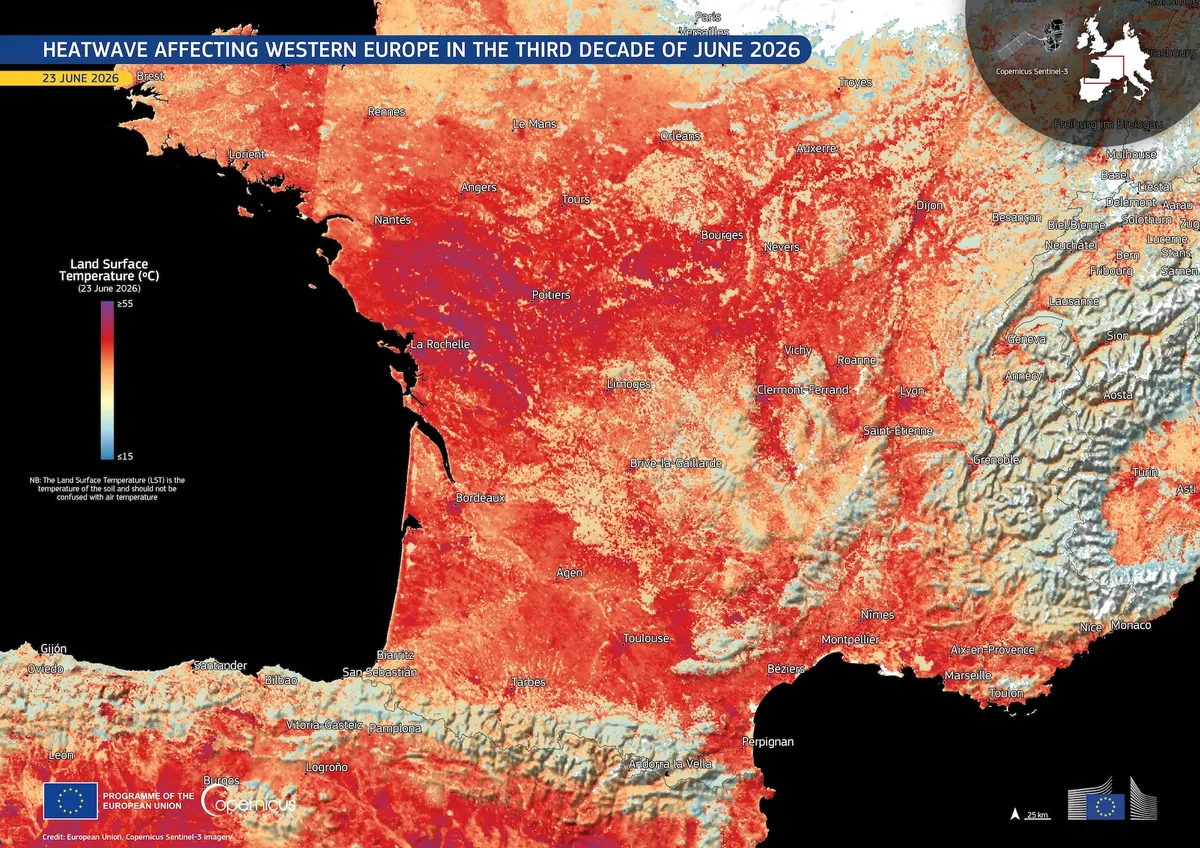
Photo: Land surface temperatures across central and southern France, and northern Spain on 23 June 2026. Credit: European Union, Copernicus Sentinel-3 imagery.
Today, experts made a first assessment to what extent the current heatwave across a large part of Europe is caused by climate change. These experts are part of an initiative called World Weather Attribution, where they analyse an extreme event right after or even during its occurrence. This way, they can present a first estimate of the attribution of man-made climate change to an extreme event when this event is still a hot topic in the media.
The experts took the summers of 1976 and 2003 for comparison. 1976 was an extremely hot summer across a large part of Europe and records were set that have not been broken for decades. 2003 was the first major heatwave of this century.
The experts concluded that this heatwave’s temperatures would have been virtually impossible to occur in June in 1976. Even in 2003, when global warming had already made extreme heat more likely, this heatwave would have been about 10 times less likely than today, while current nighttime temperatures would have been more than a hundred times less likely.
The sharp increase in the probability of extremely high temperatures illustrates the fact that extremely high – and low – temperatures have been warming much faster than the average temperature. Maximum daily temperatures have risen about three times as fast as global warming. Today’s heatwave in June would have been about 3.5 °C cooler during the day in 1976, and about 2 °C cooler in 2003. The nighttime temperatures would have been about 2.4 °C and 1.3 °C cooler in June in 1976 and 2003, respectively.
Source: World Weather Attribution