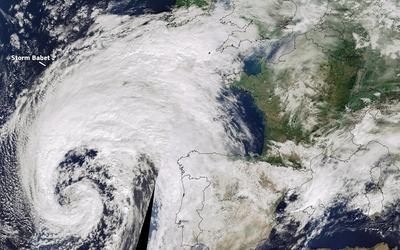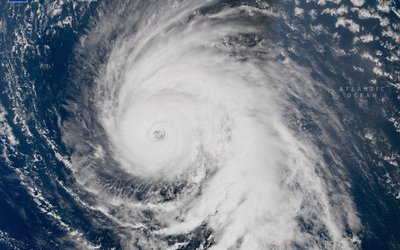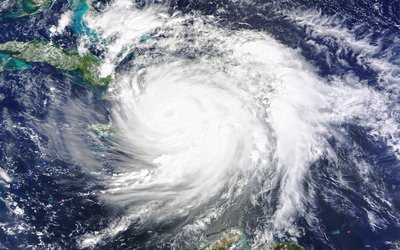
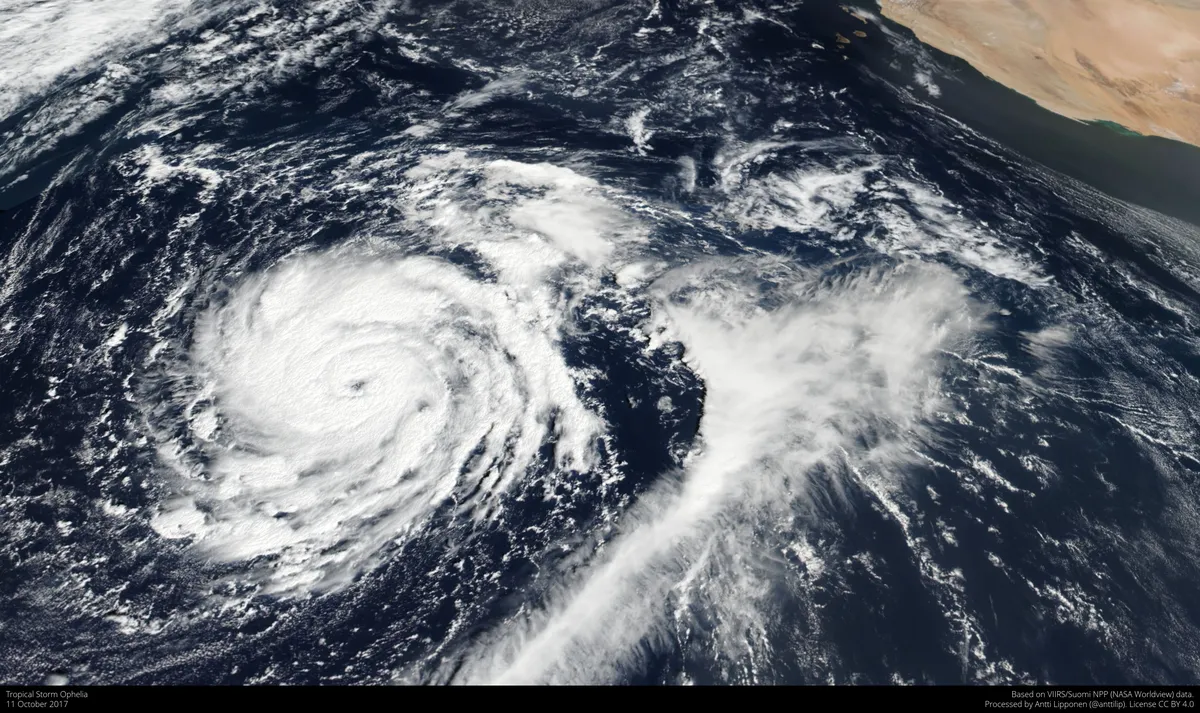
Photo: Tropical storm Ophelia (source: Antti Lipponen, www.flickr.com)
As the Earth warms so do its oceans, and the part of the Atlantic Ocean where water temperatures reach 27°C will stretch eastward — towards Europe. As a result, it is expected that tropical cyclones will also start forming closer to Europe and will not have to travel as far before making landfall there. You might accordingly expect that they will then also maintain much of their force by the time they do land in Europe. So whereas such cyclones have posed very little risk for Europe historically, that might not be true in the future.
In fact, in 2017 Hurricane Ophelia reached Ireland and Scotland, though it was an ‘ex-hurricane’ by the time it got there. It was the easternmost major hurricane to form in the North Atlantic since the satellite era. When it struck the Irish coast, it still had much of its ferocious strength.
The chance of a tropical cyclone reaching Europe appears to be increasing. Since the 1970s, the speed at which the onset of a storm over the Atlantic Ocean develops into a cyclone has increased. Moreover, the season in which these cyclones can form is becoming longer and longer.
In a recent study, Dutch scientists explored how a hurricane like Ophelia can be affected by climate change. According to them, ‘Ophelia is a representation of what we may expect more often with future warming’. They simulated how Ophelia would have developed under seven different climate scenarios: two with a cooler climate (−2 and −1 °C), four with a warmer climate (+1, +2, +3, and +4 °C), and a control simulation without global warming. Their research shows that a hurricane like Ophelia grows larger and stronger under warmer climate conditions. They also warned that such storms pose a potential threat to areas in Western Europe that are not used to these violent storms.
Source:
- Haarsma et al., 2013. More hurricanes to hit Western Europe due to global warming. Geophysical Research Letters 40: 1783-1788.
- Baatsen et al., 2015. Severe Autumn storms in future Western Europe with a warmer Atlantic Ocean. Climate Dynamics 45: 949-964.
- Garner et al., 2023. Observed increases in North Atlantic tropical cyclone peak intensification rates. Nature Scientific Reports 13, 16299.
- Patricola et al., 2024. The influence of climate variability and future climate change on Atlantic hurricane season length. Geophysical Research Letters 51, e2023GL107881.
- Ribberink et al., 2026. Tropical cyclone intensification and extratropical transition under alternate climate conditions: a case study of Hurricane Ophelia (2017). Weather and Climate Dynamics 7: 37–64.