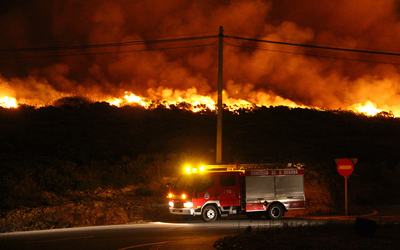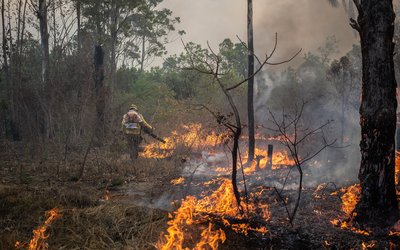
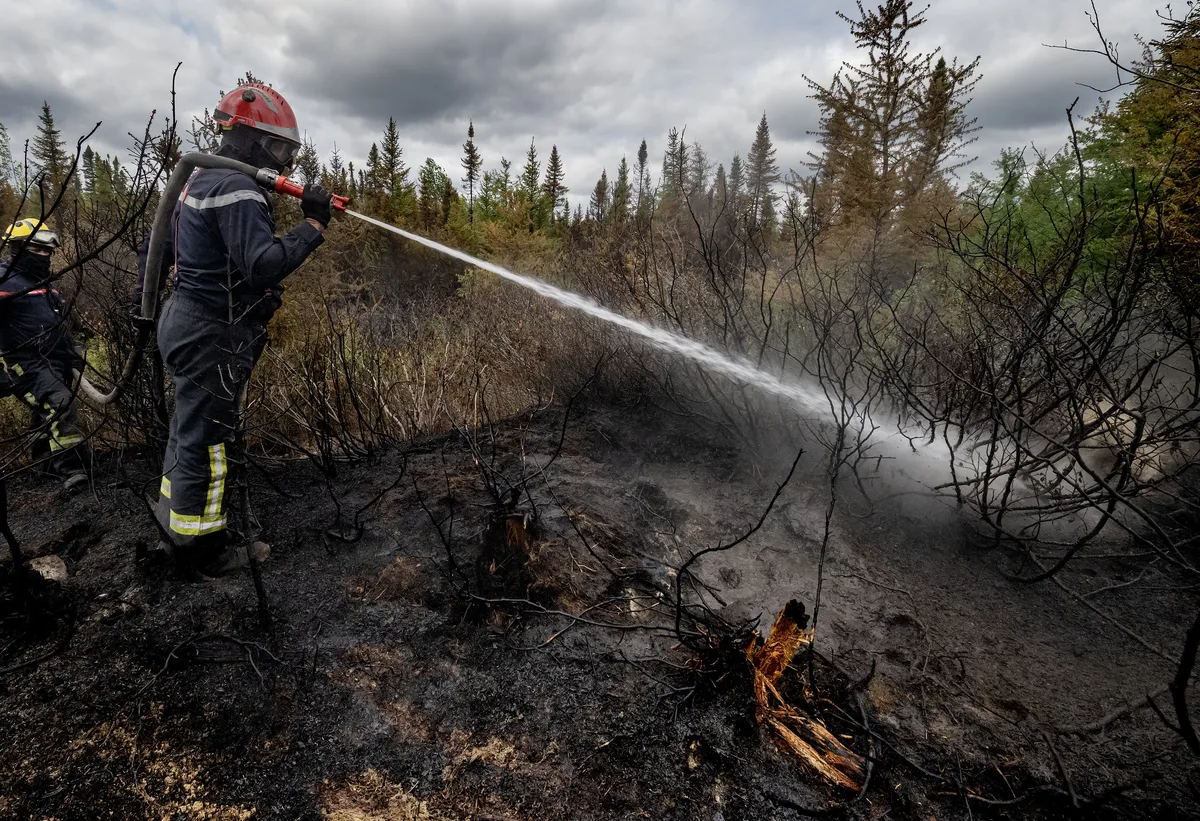
Photo: French firefighters battling wildfires in Quebec, Canada (source: European Union, 2023, P. McCabe, www.flickr.com)
Wilfried ten Brinke
In my recent book on Europe in a changing climate (so far, only published in Dutch), I wrote a chapter ‘Welcome to the Pyrocene’, on the origins of major wildfires in France and elsewhere in southern Europe. Here is a brief excerpt from that chapter.
Call for a change of course
Experts increasingly warn that wildfires threaten to become so large that they can no longer be contained. In 2020 an article was published about this in the journal Environmental Research Letters, whereby it was particularly noteworthy that the authors were experts from all around the world. What is happening in southern Europe is also happening in other parts of the world with a Mediterranean climate, in which cool, wet winters stimulate the growth of shrubbery and trees that feed wildfires in hot, dry summers. These experts are calling for a change of course. While the answer to more extreme fires in the past has been to invest more heavily in firefighting resources, that is the wrong choice, according to them.
The crux of their argument is that we need to take a closer look at the causes of these large fires and use the insight as a starting point for adopting a new approach to managing wildfires in Mediterranean-like regions.
Not just climate change
Some of the causes can be traced to climate change, but other factors may play a larger role. On the one hand, you have the abandonment of rural areas that has allowed wild vegetation to take over areas that were formerly kept clear of overgrowth. On the other, people from the cities are pushing farther and farther into natural areas for housing, so that the interaction between flammable vegetation and human beings, who are the major cause of fires, is becoming ever greater. At the same time, the introduction of new tree species that are much more flammable than those commonly growing in a particular region has further endangered parts of southern Europe.
Firefighting trap
According to the experts, policymakers have fallen into the trap of making the wrong investments because they fail to see the heart of the problem: climate change impacting landscapes where more and more fuel is able to accumulate while people, who cause many of the fires, are moving deeper and deeper into natural areas. This wrong-headed investment includes that into firefighting capacity; while this admittedly allows for small blazes to be more quickly extinguished, the accumulation of flammable vegetation continues apace, in ever-larger contiguous areas, so that any large fires then have free rein and are increasingly difficult to get under control.
Such a policy is short-sighted, the experts contend, and overly focused on keeping fires small in the short term, whereby they become unmanageable in the long term. And the problem is not southern Europe’s alone. In 2017 uncontrollable fires dominated California and the news in the United States, and not for the first time. The Los Angeles Times wrote at the time that “aggressive fire suppression has impeded the natural burn cycle in the state’s wooded areas so that there’s more fuel when the massive fires do take hold.”
Southern France as an example
Other experts cite southern France as an example. The policy there for combating large wildfires changed in 1994: more prevention, increased monitoring of forests and faster response when fires break out. The heavy investment in firefighting capacity has helped sharply reduce the number of overall fires and has been hailed as a great success, but it is one that comes with reservations. The number of smaller fires that routinely occur has dropped considerably, but those investments have had no impact on the largest fires, which occur more infrequently.
It would seem that you cannot successfully battle large fires by simply deploying firefighters; a different approach is needed. While fires bigger than 100 hectares account for only 1% of the total number of fires in the south of France, they account for 70% of the burned forest area and consume two thirds of the annual firefighting budget.
Sources:
- Evin et al., 2018. Natural Hazards and Earth System Sciences 18: 2641-2651.
- Lestienne et al., 2022. Climatic Change 170.
- Moreira, 2020. Environmental Research Letters 15, 011001.