Taking stock of Europe’s hot summer: 113 billion euros in economic losses
October 1, 2026
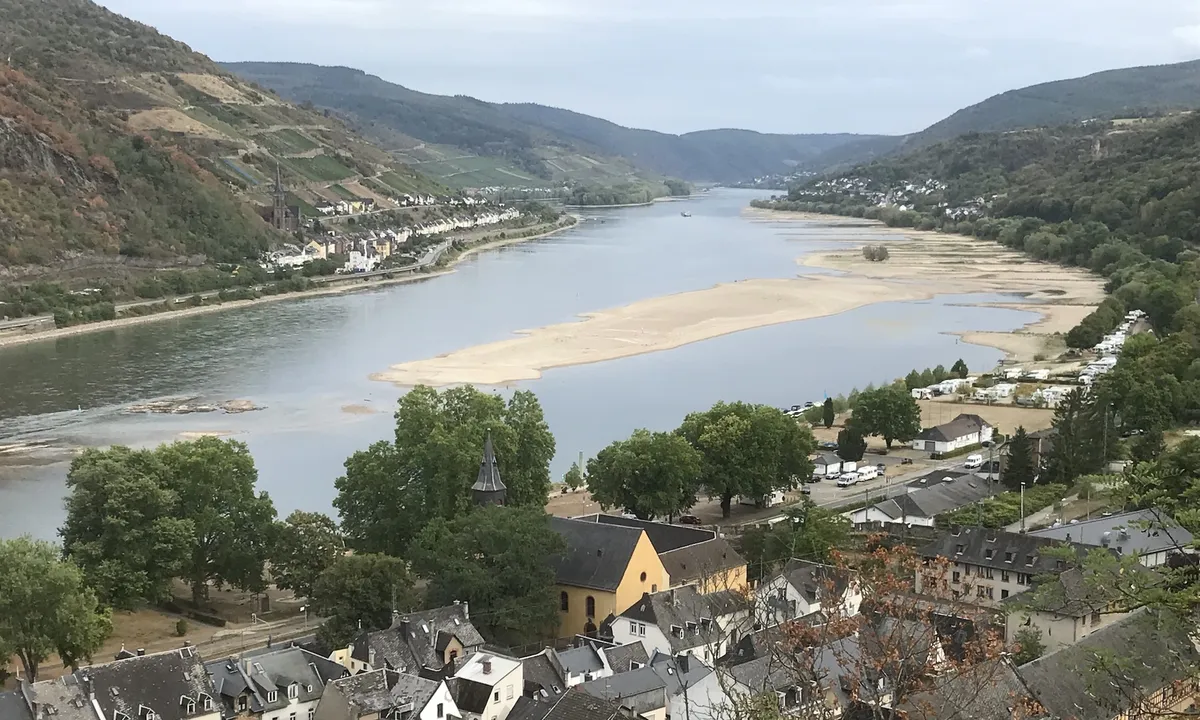
Photo: The extremely low discharge of the Rhine also contributed to the economic damage
This year’s heatwaves have cost Europe at least 113 billion euros – largely due to a loss of working hours – according to Allianz’ recent update on the economics of climate risks. This estimate for 30 European countries corresponds to approximately 0.46% of the combined projected GDP of these countries for 2026. The full impact of these costs only really sinks in when you compare them with the global extreme-weather losses recorded in the entire year of 2025: 185 billion euros. So, the economic damage of this summer’s heatwaves in Europe corresponds to 60% of the global losses because of extreme weather in 2025!
Exceeding the impact of high energy prices
These costs reflect the loss in working hours. A 0.46% loss in productivity corresponds very well to the results of a recent analysis of the vulnerability of European cities to climate change, carried out by tens of experts and reported in the prestigious journal Lancet. With respect to the decline in labour productivity, these experts conclude that the number of working hours in most European cities would have been 1.1% higher now without climate change. To put it in perspective: this impact of climate change on the European Union's GDP far exceeds the current impact of high energy prices due to tensions in the Strait of Hormuz, an analysis of the European Commission shows.
The economic damage in Europe in the summer of 2026 caused by the loss of labour productivity was largest in Italy (27.8 billion euros), followed by Germany (25 billion), France (20.1 billion), Belgium (9.4 billion) and the Netherlands (9.2 billion).
Projection El Niño
Meanwhile, Allianz also presented an estimate of the global economic costs of the strong El Niño that will peak towards the end of this year and persist into early 2027: 397 billion euros. For the European Union, the consequences are limited, with projected losses reaching 21 billion euros, or 0.09% of GDP. However, these losses do not include all economic effects, such as inflation and additional losses from floods, droughts, wildfires and other extreme events.
More than direct damage
Previous studies showed that, in financial terms, the greatest impact of climate change will be on healthcare. The loss of labor productivity ranks second. While the direct damage caused by extreme weather events to buildings and infrastructure can be substantial, it is generally relatively minor compared to the loss of labor productivity. The torrential rains and floods in the summer of 2021, for instance, resulted in some 46 billion euros in damage in Germany, Belgium and the Netherlands. This damage was unprecedented in Europe, but still much less than the estimated loss of this year’s productivity amounting to 113 billion euros.
Increasing trend
Heat stress-related losses in labour productivity are increasing. A recent estimate of the current annual loss in work time due to extreme heat in the construction, agricultural, forestry and fishing industries is 650 billion working hours. The experts behind this estimate attached a global GDP loss of 1.7% to these 650 billion working hours. They also estimated that these heat stress-related losses in labour productivity have increased by 9% since the end of last century because of global warming. An acceleration of the loss working hours is projected for the coming decades.
Limited impact on Europe
Estimates of the economic consequences of climate change vary widely. One thing all studies do agree on is that these consequences will be relatively small for Europe compared to the rest of the world. Swiss Re, one of the world’s largest providers of reinsurance, projects a 3% weaker economy for Europe if the Paris targets are met, and an economy that is 8% smaller if we end up with the more likely 2.0°C – 2.6°C of global warming.
Sources:
- Allianz Climate Economics Report 2026: A year of escalating costs.
- Borg et al., 2021. Environmental Research 195, 110781.
- European Commission. Scenario Analysis 21 May 2026.
- Munich RE NatCatSERVICE, 2022. Factsheet natural catastrophes in 2021.
- Swiss Re Institute, 2024. Changing climates: the heat is (still) on.
- Watts et al., 2021. Lancet 397: 129-170.