
The share of the European population living in cities is expected to grow from 75% in 2018 to 84% in 2050. These city dwellers are increasingly facing health risks due to growing hazards because of climate change. However, these risks are still poorly addressed. Adaptation measures are being implemented but are not sufficient. Only 0.5% of recent urban adaptation and mitigation projects directly addressed health systems and services.
Recently, the prestigious journal Lancet presented an analysis of climate change-related health effects in 885 European cities. The analysis was carried out by tens of experts from all over Europe.
Improving air quality
The transition away from fossil fuels is improving air quality in European cities. Northern Europe is leading the way here. Along with the largest decrease in emissions from fossil fuel use, the decrease in mortality attributable to fine particles from burning fossil fuels is also largest in northern European cities. In eastern European cities, in 2023, this mortality was more than three times that of northern cities.
Long-term exposure to these fine particles – from many sources – is the main environmental risk factor for human health in the EU, with 346.000 deaths in 2023. Thanks to a strong decrease in this exposure in recent decades, total premature deaths attributable to these particles has decreased in European cities by 40% since 2000.
More heat-related mortality
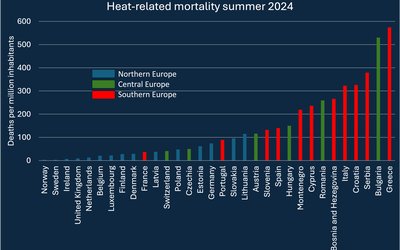
Especially heat-related mortality and health effects of wildfire smoke have increased over time. Heat-related mortality has increased in almost all European cities. The increase was highest in the cities of southern Europe. There, heat-related mortality has increased by 160% between the 1990s and the past decade. The increase of the number of events with dangerous wildfire smoke is much more modest: 7% from 2003 to 2023.
On the positive side, the number of trees – and consequently their effect on lowering temperatures on hot summer days – has increased in 88% of European cities. Since 2000, the increase in the number of trees was largest in eastern and northern Europe.
More vector-borne diseases
All over Europe, the climate has become more suitable to dengue, chikungunya and Zika. Across European cities, the average risk of dengue transmission has increased by 110% in the period 2015–2024 compared with 1981–2010. The increase was largest in eastern European cities (369%) and lowest in the cities of northern Europe (12%). Similar trends were found for chikungunya and Zika viruses.
Concentrations of allergenic pollen more than doubled in southern and eastern European cities from the 1990s to the period 2015–2024, increasing exposure and morbidity of patients with allergic rhinitis.
Less productive
Labour productivity has also declined. The number of working hours in most European cities would have been 1.1% higher now without climate change.
Three priorities
According to the experts, climate action in cities must focus on three priorities. First, heat-related health effects must be tackled immediately by strengthening early warning and improving adaptation. Second, the urban environment must be changed, increasing the number of trees in the city, using building materials that absorb less heat, increasing the permeability of urban surfaces, and stimulating public transport. Third, the reduction of the emissions of greenhouse gasses must be accelerated to benefit from major health gains from reduced air pollution.
Source: Chen-Xu et al., 2026. Lancet Public Health 11: e797–818.