Dangerous beauties: Glacier lakes and the risk of devastating floods
August 27, 2026
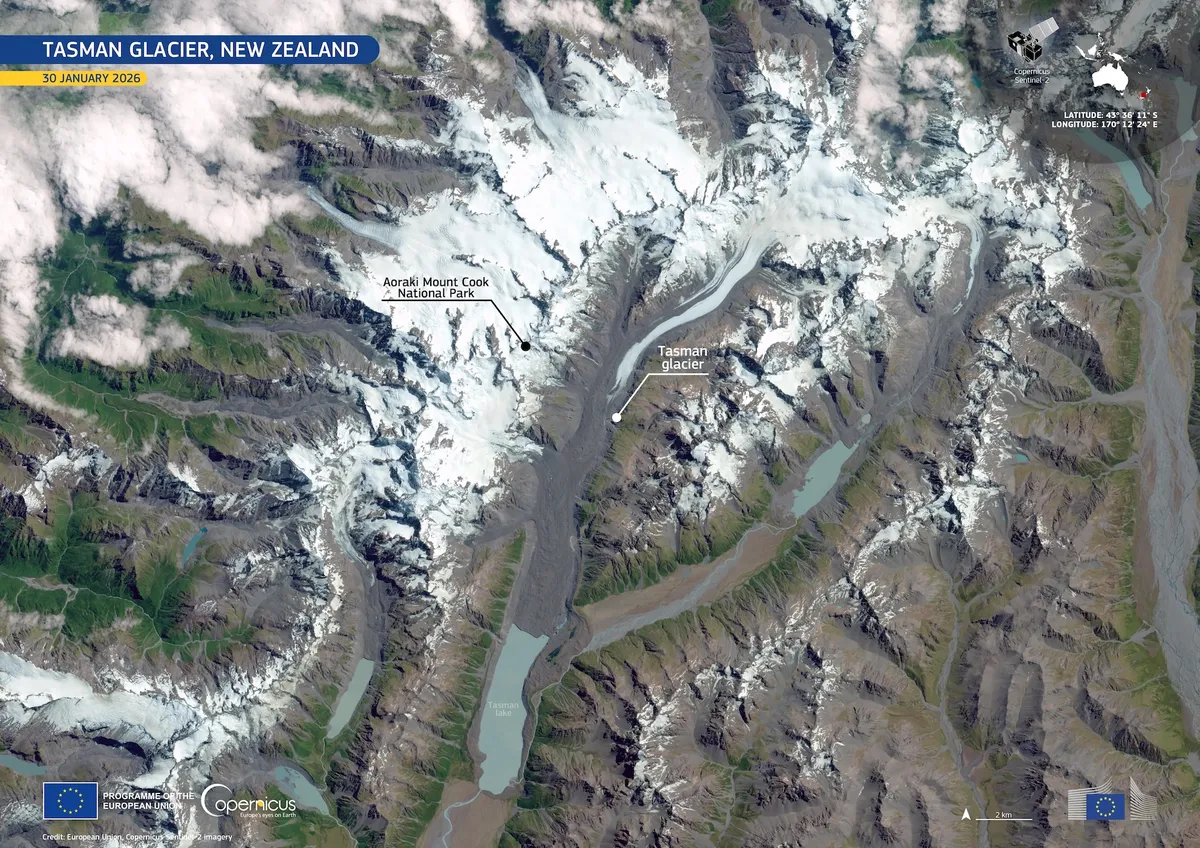
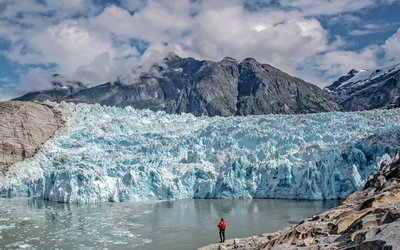
Photo: An example of glacier lakes (turquoise tones) at the foot of a glacier – in this case the Tasman Glacier in New Zealand. Credit: European Union, Copernicus Sentinel-2 imagery.
The recent flood disaster in Tibet was likely caused by the bursting of a glacier lake. What do we know about these lakes, the risk of flooding and the link to climate change?
When a glacier recedes
Glaciers are surrounded by moraines, piles of debris they once carried along or pushed before them. When a glacier recedes, the meltwater accumulates in the space behind the moraine. As the glaciers gradually disappear, therefore, lakes will be formed at various places in the mountains. In addition to melting glaciers, these lakes can also be formed by the release of water when ice in the subsurface melts or when permafrost thaws.
Dangerous beauties
Swiss scientists have called several of these lakes in ‘their’ Alps ‘dangerous beauties’. The concern is about lakes that are formed at the foot of unstable mountain slopes. There is a danger that the ‘banks’ of these lakes, the accumulated debris around their shores, will give way if too much water flows into the lakes or if debris flows or avalanches of loose rocks or pieces of ice from the mountainsides burst through them.Moraine walls can also collapse if the ice in the wall melts, causing the protective barrier of glacial debris to effectively fall apart. If villages downstream were to be hit by a wave of water and debris coming down from the mountains, the consequences could be catastrophic. And the danger appears to be real.
They quickly fill up
Scientists have calculated for the Swiss Alps how much water these lakes can hold and it amounts to just 3% of the volume of the current glaciers. The lakes would therefore quickly fill up. With the right measures, though, the risk of flooding from these lakes can be managed, such as releasing water from a lake – or completely draining the lake – if the water level threatens to become too high or creating space downstream to capture and contain the floodwater before it can cause any damage.
Bursting the banks
The unstable mountainsides that threaten these lakes were stable when the glaciers were still there, but as the glaciers recede so does the support the ice once gave to the steep slopes of the mountains, bringing the risk of falling rocks or even landslides. Such rock avalanches and landslides can themselves also cause damage and lead to casualties. As well as bursting the banks of lakes they can themselves lead to the formation of lakes if they block the flow of meltwater from the glacier. As the glaciers melt, the risk of these mass movements and catastrophic consequences arising from the ‘dangerous beauties’ will only increase.
Climate change?
Just like landslides and other mass movements in the mountains, no connection between glacial lake outburst flooding and climate change has yet been established. Even a major study of the occurrence of these floods worldwide since the beginning of the 19th century has not come up with any conclusive evidence. Indeed, such floods have not become more frequent in recent decades, despite the retreat of the glaciers and formation of glacial lakes. Again, it is the many other factors, such as the composition of the glacial moraine, the part played by earthquakes, the many years it can take before a mountainside becomes unstable and collapses into a lake, and artificial emptying of lakes that make it impossible to establish a clear connection with climate change. The number of these lakes worldwide is increasing rapidly, though, by 53% between 1990 and 2018. The risk of glacial lake outburst flooding is largest by far in Asia and in the Andes; the risk is relatively low in Europe.
Sources:
- Gärtner-Roer, I. et al., 2022. Glacier–permafrost relations in a high-mountain environment: 5 decades of kinematic monitoring at the Gruben site, Swiss Alps. The Cryosphere 16: 2083 - 2101.
- Haeberli, W. et al., 2016. New lakes in deglaciating high-mountain regions - opportunities and risks. Climatic Change 139: 201-214.
- Harrison, S. et al., 2018. Climate Change and the Global Pattern of Moraine-Dammed Glacial Lake Outburst Floods. The Cryosphere 12: 1195-1209.
- Kos, A. et al., 2016. Contemporary glacier retreat triggers a rapid landslide response, Great Aletsch Glacier, Switzerland. Geophysical Research Letters 43: 12,466-12,474.
- Kattel, D.B. et al., 2020. Evaluation of Glacial Lakes and Catastrophic Floods on the Northern Slopes of the Kyrgyz Range. Mountain Research and Development 40 (3): 37-47.
- Shugar, D.H. et al., 2020. Rapid worldwide growth of glacial lakes since 1990. Nature Climate Change 10: 939-945.
- Taylor, C. et al., 2023. Glacial lake outburst floods threaten millions globally. Nature Communications 14, 487.