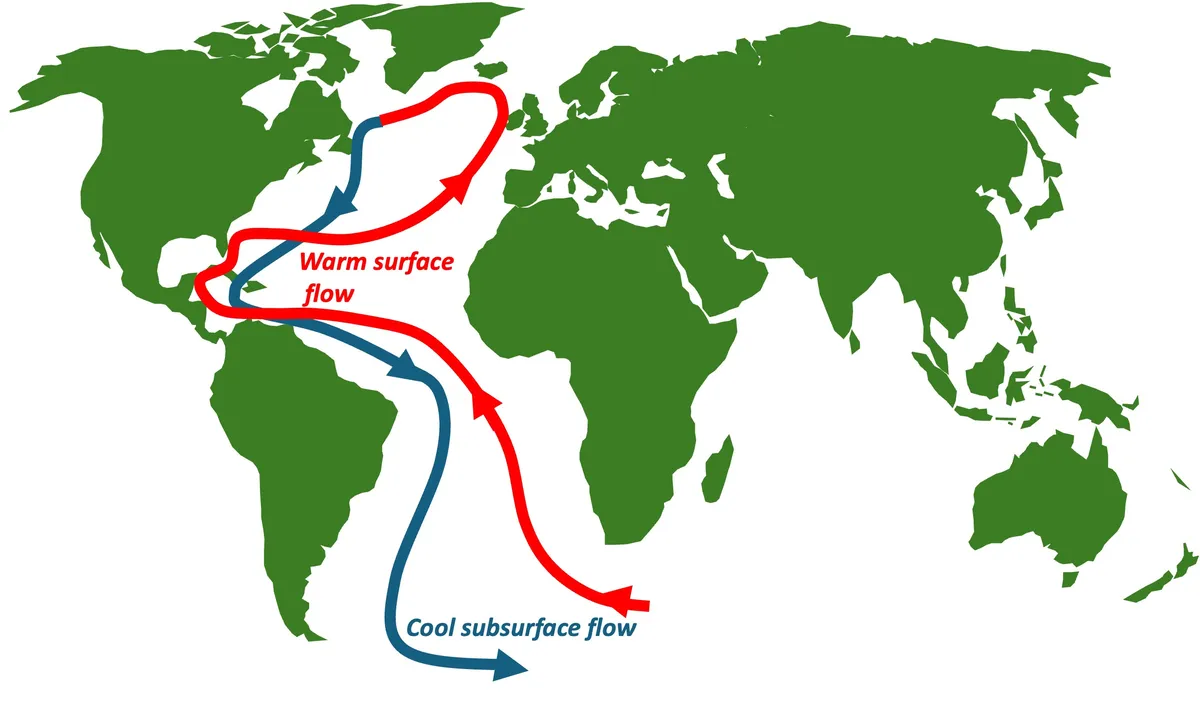
It is very likely that the ocean current that gives Western Europe its relatively warm climate will lose about half of its strength by the end of this century. If so, a further slowdown is to be expected in the next century, with dramatic consequences not only for Europe but for Africa and the Americas as well. This message is the result of a recent study – published in the journal Science Advances – into the likelihood of a weakening of this current according to climate models.
The AMOC
It is one of the potential climate tipping points that scientists have been warning about for years. The scientific term for this current is the Atlantic Meridional Overturning Circulation, or AMOC for short. This current brings warm water from the southern hemisphere to the northern Atlantic Ocean. Once there, the water has become saltier and cooled due to evaporation. As a result, it becomes heavier, sinks several kilometers deep, and then flows back south. It is a kind of ‘conveyor belt’ for ocean water, with the supply of heat at the surface and the removal of cold deep in the ocean. The Warm Gulfstream that most people know is part of the AMOC.
The slowdown
With the melting of the Greenland ice sheet, increasingly more freshwater is flowing from the ice sheet into the northern Atlantic Ocean. The ocean here is also receiving an increased supply of freshwater because it is raining more here due to climate change. As the ocean water consequently becomes sweeter and therefore lighter, the sinking of the cooling water of the AMOC may be slowed. In addition, air temperatures are rising rapidly in the Arctic because of global warming. This also affects water temperature and the AMOC since warmer water is less dense and therefore sinks more slowly.
The slowdown of the AMOC puts the supply of heat to north-western Europe at risk. There are now the first indications that the scientists might well be right: the speed at which the AMOC flows has slowed slightly since the middle of the last century, and the expected consequences of this – a cooling of the ocean water between Canada and north-western Europe – appear to be actually manifesting. Moreover, this development is not a theoretical scenario; it has happened quite often in the distant past.
The consequences
The consequences of a slowdown of the AMOC would be dramatic. Climate warming in northern and western Europe would turn into a significant cooling. Elsewhere in Europe, and globally, warming would actually intensify because heat would no longer be transported to the North Atlantic Ocean. The AMOC slowdown would affect food production, among other things, lead to more extreme weather, and a faster rise in sea level. The consequences would also be major far away from Europe. Precipitation patterns would shift, jeopardizing food production and causing rainforests to dry out while the climate elsewhere becomes much wetter, resulting in floods.
Knowledge so far
The current generation of climate models agree that the AMOC will likely decline in the 21st century. The models disagree on the exact magnitude of such a decline. The uncertainty of model projections results from three sources: (1) the uncertainty of future scenarios of climate change, (2) the natural variability of the behaviour of the AMOC, and (3) model uncertainty. The uncertainty of the AMOC projections at the end of this century mainly results from model uncertainty. The disagreement in model projections is large, varying from no further slowdown by 2100 to a 65% slowdown.
Recent study
In this recent study in the journal Science Advances, the scientists combined real-world ocean observations of the last 20 years with the models to find the models with the most reliable projections. This allowed them to reduce the spread of uncertainty to an estimated slowdown of 51 ± 8% in 2100. This is the slowdown compared to the strength of the AMOC in the second half of the 19th century, the reference in this study. The probability of this slowdown is 90%, meaning that – according to this study – there is a 10% change that the AMOC slows down more or less than this range of 51 ± 8% in 2100.
In their study, the authors used a moderate scenario of climate change. However, they demonstrated that the conclusions of their study remain robust for lower or higher climate change scenarios.
Close to a tipping point
The study shows that the AMOC may be close to a tipping point. Moreover, a further slowdown is to be expected after 2100, possibly leading to a collapse of this ocean current.
One of the world’s experts on the AMOC, Prof. Rahmstorf of the Potsdam Institute for Climate Impact Research, has repeatedly expressed his concern about the AMOC slowdown. In the Guardian, referring to these latest findings, he commented: “This is an important and very concerning result. It shows that the ‘pessimistic’ models, which show a strong weakening of the AMOC by 2100, are, unfortunately, the realistic ones, in that they agree better with observational data. I now am increasingly worried that we may well pass that AMOC shutdown tipping point, where it becomes inevitable, in the middle of this century, which is quite close.”
These recent insights paint a bleak picture of the future, particularly for north-western Europe, but also for large parts of the world. In western and northern Europe, winters would become extremely cold while summer droughts would occur more frequently and be more intense. In addition, sea levels around the Atlantic Ocean could rise by another 50-100 cm on top of current projections as early as 2100.
Source: Portmann et al., 2026. Science Advances 12, eadx4298.
and:
- Caesar, L. et al., 2018. Observed fingerprint of a weakening Atlantic Ocean overturning circulation. Nature 556: 191–196.
- Lynch-Stieglitz, J., 2017. The Atlantic Meridional Overturning Circulation and abrupt climate change. Annual Review of Marine Science 9: 83-104.
- Piecuch, C.G. en L.M. Beal, 2023. Robust weakening of the Gulf Stream during the past four decades observed in the Florida Straits. Geophysical Research Letters, 50, e2023GL105170. DOI: org/10.1029/2023GL105170.
- Rahmstorf, S. 2024. Is the Atlantic overturning circulation approaching a tipping point? Oceanography 37 (3): 16-29. DOI: 10.5670/oceanog.2024.501.
- CarbonBrief, 2026. Is global warming tipping key Atlantic ocean currents towards collapse?