Current adaptations will hardly reduce mortality in Europe from future heat waves
February 6, 2026

Fifteen thousand deaths in two weeks’ time. Crematoria and cemeteries unable to cope with the stream of bodies. Overflowing mortuary chambers. Paris will never forget the summer of 2003 — but not because of the wonderful weather.
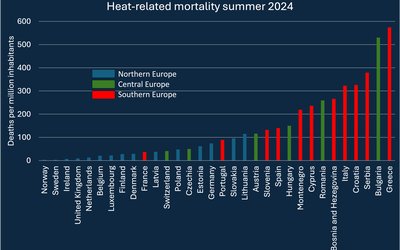
That year showed just how deadly heatwaves can be when, during a series of them, 44,000 people in western Europe succumbed to the heat. Things were particularly bad in France, with 15,000 heat-related deaths in the space of two weeks. The images of overflowing morgues sent shock waves around the world, showing just how unprepared the country was for such a situation. Its healthcare system was overburdened, nursing homes lacked air conditioning as well as nursing staff, and many elderly people had to fend for themselves at home without knowing how to protect themselves against the heat.
What if …
Meanwhile, global warming has continued for more than 20 years. Scientists asked themselves: what if these meteorological conditions of August 2003 would recur under current climate conditions, being 1.5 °C global warming relative to pre-industrial times? And how many casualties can we expect if these meteorological conditions recur under projections of 2 °C, 3 °C and 4 °C global warming?
They calculated heat mortality for these hypothetical yet plausible cases by combining climate model projections, historically observed meteorological patterns, and data relating temperature to mortality. In fact, they did so for five extreme heat events in the past: July 1994, August 2003, July 2006, June 2019 and August 2023. They also estimated heat mortality for these events by assuming global warming does not exit.
Peak COVID mortality
They showed that of these five events, the largest death toll is associated with the 2003 conditions. If the meteorological conditions of August 2003 would recur today, at 1.5 °C global warming, there would be 17,800 excess deaths across Europe in one week. This number would rise to 32,000 at 3 °C global warming, a mortality comparable to peak COVID-19 mortality in Europe.
The second largest death toll is associated with the 1994 conditions: 26,500 excess deaths in one week at 3 °C global warming. The other three events are associated with weekly peaks in between 18,800 and 25,600 excess deaths at 3 °C global warming.
70 to 80% due to global warming
The study also revealed that climate change is already a dominant contributor to mortality during extreme heat events. For example, there would be 9,000 excess deaths in one week at the peak of a 2003-like event without global warming. At 3 °C global warming, there would be an additional 23,000 excess deaths, making anthropogenic warming responsible for 72% of the death toll. For all five events, the contribution of global warming to mortality at 3 °C global warming is estimated to be in between 70 and 80%.
Little relief by adaptation
The authors of this study are not very optimistic about the potential relief that climate adaptation could bring to these numbers. Across the five studied events, incorporating adaptation reduces peak mortality by only 10% on average. The authors conclude that “while mitigating further global warming can reduce heat mortality, mass mortality events remain plausible at near-future temperatures despite current adaptations to heat”. They see “limited potential for currently deployed adaptation approaches to reduce the mortality impacts of these extreme climate events”.
Source: Callahan et al., 2026. Nature Climate Change 16: 26-32.