Coastal erosion and coastal floods
Wadden Sea more vulnerable to sea level rise than previously thought
December 10, 2025
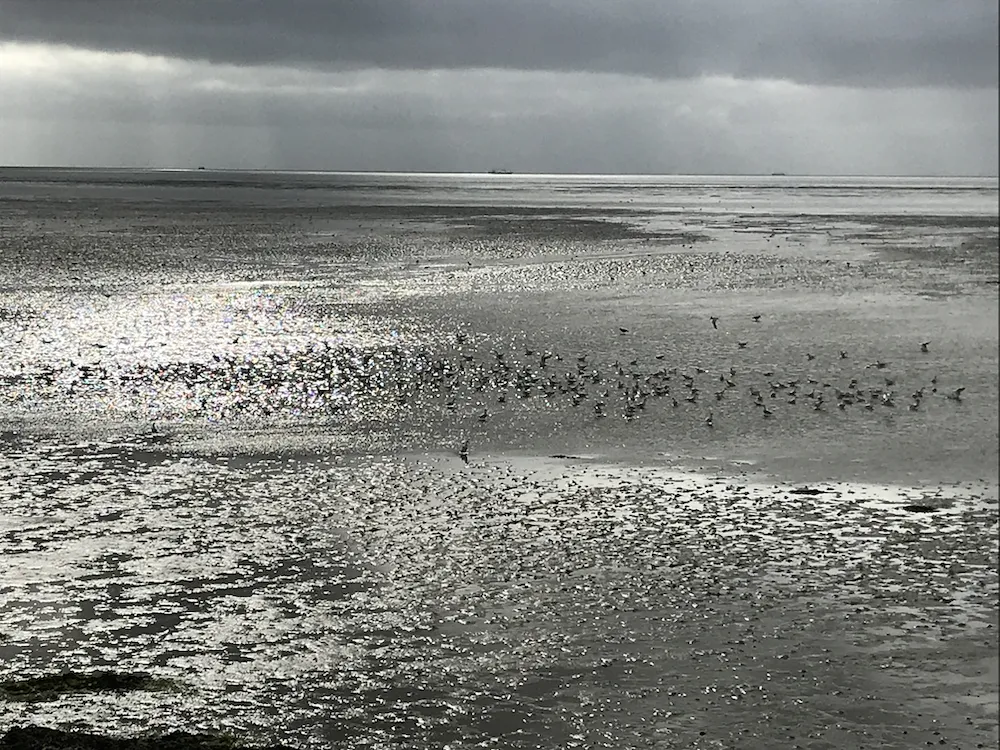
The Wadden Sea is a UNESCO World Heritage site along the coasts of Denmark, Germany and the Netherlands. The large area of tidal flats plays a major role in global biodiversity. The area is also vulnerable to sea level rise. At continuing acceleration of sea level rise a tipping point may be reached where sedimentation of the tidal flats will no longer be able to keep pace with sea level rise, and the tidal flats start to drown. For many experts, the question is not if, but when this will happen. The main question for the Wadden Sea is: how quickly can the tidal flats grow in relation to the accelerating sea level rise?
Misleading data
Until about 15 years ago, the elevation of the tidal flats in the Wadden Sea was underestimated. According to the measurement data they were much lower than in reality. This makes it appear as if these areas have become much higher since then. The estimated long-term trend of mean elevation change – based on these data – appears to be keeping pace with sea level rise. This impression is misleading. In reality, sedimentation onto these tidal flats is much lower and parts of the Wadden Sea already seem to be struggling with the accelerating sea level rise, German scientists show in a recent publication in the journal Communications Earth & Environment.
Good news, and a risk
Over the past decades, techniques for measuring seabed elevation in areas like the Wadden Sea have improved significantly. We can now observe small-scale topographic features, including creeks and streams with width less than 10 m, that were previously undetectable with conventional measuring techniques. The resolution of the measurements is now much better. This is good news, but it also entails a risk.
Due to the limited resolution of measurements until about 15 years ago, elevation differences at short distances were missed. When interpolating the measurement data into a contour map of the area – a so-called Digital Elevation Model DEM – this led to an underestimation of the elevation of tidal flats. These flats in the Wadden Sea were higher than the contour maps showed. German scientists analysed 25 annual DEMs spanning from 1998 to 2022. They found that the calculated mean elevation in the oldest Dems in their time series was about 10 mm lower than the actual situation in the Wadden Sea, simply because of a relatively low resolution of the data.
Overestimation growth tidal flats
In recent years, the resolution of the measurements has increased significantly, and the elevation differences at short distances are now much more accurately measured. As a result, the elevation of the tidal flats is no longer underestimated, or at least much less so. If you now stitch together decades of data on the elevation of the tidal flats to derive the trend of elevation change, it would appear as if the tidal flats are growing vertically so quickly that they can easily keep pace with sea level rise. This is not correct, and the data are misleading, according to this German study.
The trend of elevation change has been significantly overestimated because the elevation of the tidal flats was underestimated in the past. In reality, the tidal flats grow much slower, and the trend of elevation change is not sufficient to allow all tidal flats to keep pace with accelerating sea level rise.
The German scientists corrected their time series for this effect of higher resolution in more recent data. They quantified the elevation trend according to both these corrected data and the original data. According to the original data, almost all tidal flats are growing vertically, by 0.7–19.3 mm per year. The corrected data showed considerably lower growth rates: a reduction between 0.2 and 6.8 mm per year.
Actual resilience much less
The overestimation of the growth rates of the tidal flats in the Wadden Sea is highly relevant when compared with the rate of sea level rise. In the original data, accretion rates of tidal flats are higher than the rate of sea level rise in most of the tidal basins of the Wadden Sea. According to the corrected data, this is the case in less than half of these basins.
The actual resilience of the Wadden Sea is much less than one would conclude from the original data. The authors of this study conclude that current and future adaptation needs for coastal protection of the Wadden Sea are likely much higher than previously assessed.
Source: Miao et al., 2025. Communications Earth & Environment 6: 904.