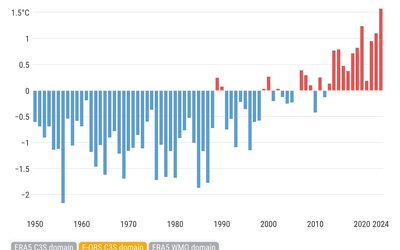

Ocean heat: 90% of global warming
Changes in global mean sea surface temperature reflect man-made global warming, but it’s not a perfect indicator of climate change. After all, sea surface temperature fluctuates because of several processes including local warming and cooling because of El Niño and La Niña. The heat content in the upper 2000 metres of all oceans combined is a more robust indicator since it is far less sensitive to this short-term variability in heat redistribution across the water column.
The state of the oceans in 2025 was assessed by analysing data on ocean heat content and sea surface temperature from various research institutes worldwide for the period 1958-2025. This information is highly relevant as the oceans absorb more than 90% of the excess heat generated by human-induced global warming.
Ocean warming is accelerating
Observations show that this heat content has increased robustly since at least 1958. Since 1986, the pace of warming has increased more than threefold, and since 2007 more than fourfold, compared with the period 1958–1985. Ocean warming continues to accelerate. Since 1958, ocean heat content was highest in 2025, signalling robust climate warming.
Global annual mean sea surface temperature in 2025 was 0.49°C above the 1981–2010 baseline. It was slightly lower than in 2024. From 2024 to 2025, El Niño ended and La Niña developed, leading to continued cooling toward the end of 2025. Global mean sea surface temperature in 2025 still ranked as the third highest on record.
Mediterranean Sea
The North Atlantic and the Mediterranean Sea are changing. In addition to the accelerating warming, the North Atlantic and the Mediterranean Sea are also climate hotspots of salinization, deoxygenation, and acidification, making the ocean ecosystems and the life they support more fragile. The Mediterranean Sea has warmed particularly strong in 2025, significantly exceeding the long-term trend observed between 2004 and 2024.
Impacts
Ocean warming affects our life in many ways. The sustained and intensifying warming contributes to faster sea-level rise via thermal expansion, leads to more frequent and intense marine heatwaves, and intensifies extreme weather events. Strengthening the ocean observing system and increasing our knowledge of heat redistribution in the oceans are therefore essential for adaptation planning.
Source: Pan et al., 2026. Advances in Atmospheric Sciences. DOI: 10.1007/s00376-026-5876-0.