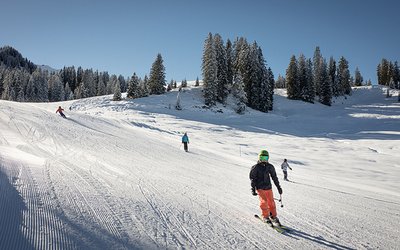
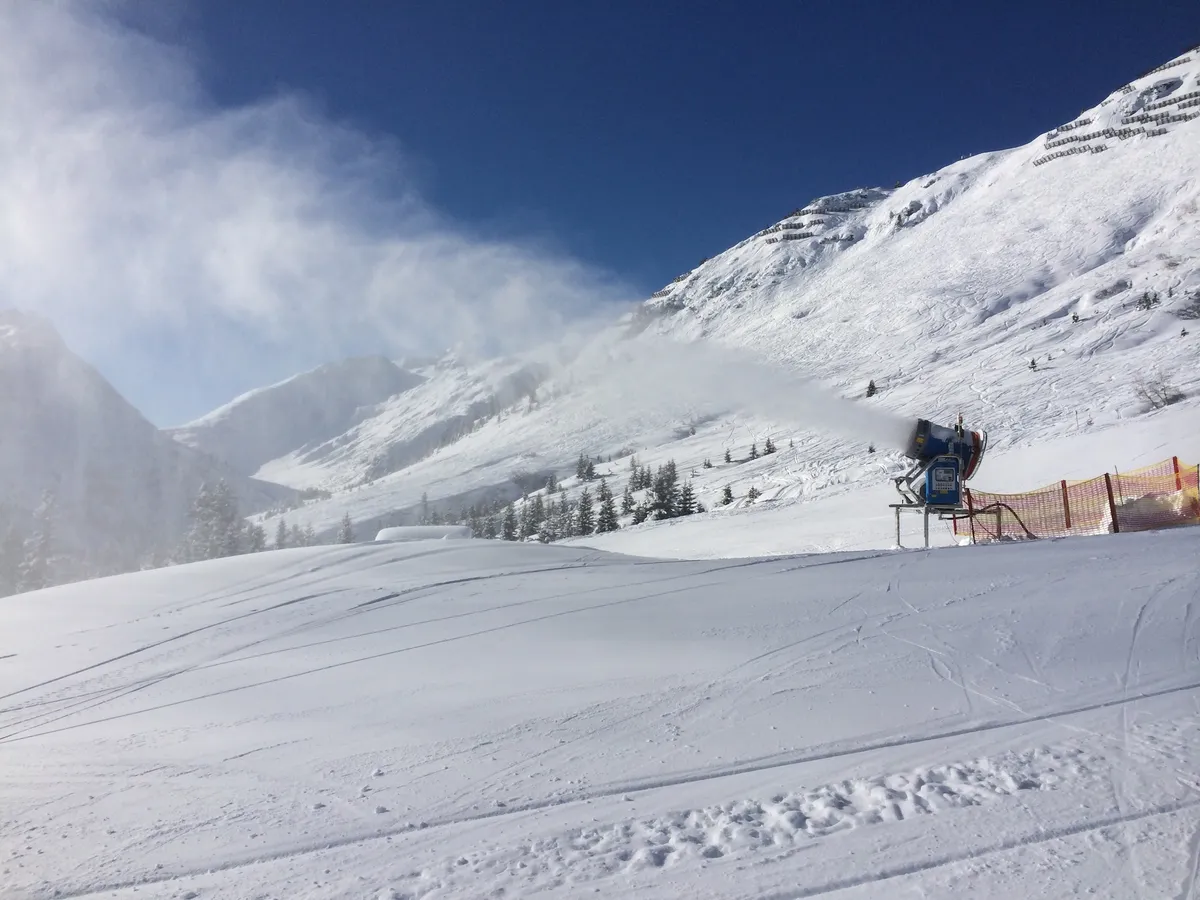
The Alps are far and away the largest ski region in the world. An astounding 43% of the world’s skiers take to the slopes there, with 85% of Europe’s ski resorts located in the French, Swiss, Austrian and Italian Alps.
It will come as little surprise to anyone that the amount of snow in the mountains of Europe is going to gradually decline in this century. For the highest slopes in the Alps, above 2000 metres, things are not expected to get too bad, even towards the end of the century and even if global warming continues apace. But at lower altitudes the effects will be great.
Recent decades
An Alpine-wide analysis of snow depth from six Alpine countries – Austria, France, Germany, Italy, Slovenia, and Switzerland – shows that between 1971 and 2019 mean snow depth in the months November to May has decreased by 8.4 % per decade. Both maximum snow depth and snow cover duration have decreased by 5.6 % per decade. The magnitude of these trends differed by region: the decreases in the south of the Alps were on average stronger than in the north. An analysis of the long-term trend in snow depth in the Italian Alps – covering the period 1930–2020 – showed that the lowermost values for snow depth generally occurred in the last few decades (1991–2020), irrespective of elevation.
The near-future
The recent waning of snowpack in the Alps is unprecedented in the last six centuries. For the near-future, snow mass loss will be most pronounced at lower elevations; since the end of the previous century, annual snow cover duration is declining by 5 days per decade, on average. Projections indicate that average snow cover duration at lower elevation in the Alps, and in many regions across the globe, will decrease by 30%, 50% and 80% by the end of this century under a low, moderate, and high scenario of global warming, respectively.
Economic effects
A great deal of research is being done into the consequences of climate change for winter sports in the Alps, which is understandable given the huge economic repercussions. For instance, an annual loss in hotel revenues in Europe of 560 million euros has been estimated under a 2°C global warming scenario, and not including adaptation by artificial snowmaking, compared to the end of the previous century.
The 100-day rule
There is a rule for determining when a winter sports resort can be considered ‘snow-reliable’: the 100-day rule. A ski destination has sufficient snow reliability when it has a snow cover of at least 30 cm, meaning you can ski there, for at least 100 days between 1 December and 15 April in seven out of 10 winters. In practice, this is now the case in the Alps at elevations above 1200 metres. At the beginning of this century, 91% of the ski areas in France, Switzerland, Italy, Austria and Germany were snow-reliable, which amounts to over 600 of the 666 ski areas in those countries. But that number drops quickly as the Earth warms up further, to an estimated 400 with a 2°C and 200 with a 4°C rise in temperature. Lower-altitude ski resorts are the most vulnerable.
Sources:
- Agrawala (ed.), 2007. Climate Change in the European Alps. Report OECD.
- Carrer et al., 2023. Nature Climate Change 13: 155-160.
- Colombo et al., 2022. Journal of Hydrology 614, 128532.
- Damm et al., 2017. Climate Services 7: 31-46.
- Elsasser and Bürki, 2002. Climate Research 20: 253-257.
- IPCC, 2019. IPCC Special report on the ocean and cryosphere in a changing climate.
- Matiu et al., 2021. The Cryosphere 15: 1343-1382.
- Monteiro and Morin, 2023. The Cryosphere 17: 3617-3660.
- Vanat, 2021. International report on snow & mountain tourism. 13th edition.