Coastal erosion and coastal floods
Deltas are vulnerable even if we stop subsidence
January 26, 2026
“The acceleration of sea level rise will determine the future of our deltas. At the global scale, fifty years from now, we may start losing deltas and low-lying coastal areas.” This conclusion was drawn from an analysis of scientific studies into the capacity of deltas and coastal zones to keep pace with accelerating sea level rise through sediment supply and accretion.
One of the building blocks of this analysis is a geological study on the formation of the world’s deltas after the melting of the ice of the last ice age. This study showed that most deltas were formed when the rate of sea level rise slowed down between 9,000 and 7,000 years ago to 5–10 mm/year. Apparently, the sediment volumes deposited by rivers in coastal seas were large enough to keep up with sea level rise and build deltas at this rate of 5 to 10 mm sea level rise per year.
The key to the future
The past may be the key to the future. Now that sea level rise is accelerating, reaching this range of 5 to 10 mm per year sea level rise may be critical for the future of our deltas and low-lying coastal areas. Indeed, several studies indicate that these environments are likely to drown at some point when sea level rise reaches this critical range, unless they are properly protected against erosion and flooding. Globally, sea levels are currently rising at an average rate of about 4.5 mm per year, and this rate is increasing by an additional 1 mm every ten years. So clearly, we are about to enter this uncharted territory.
A critical range
This critical range does not refer to absolute sea level rise, but to sea level rise relative to land elevation. Many of the world’s deltas and low-lying coastal areas are sinking. In these environments, relative sea level rise is much closer to the critical point at which these environments begin to submerge than one might infer from absolute sea level rise alone. A recent study published in Nature quantified the subsidence for 40 major river deltas globally and showed that subsidence often exceeds absolute sea level rise. Let’s have a closer look at these data in view of the critical range of 5–10 mm/year.
Sinking deltas
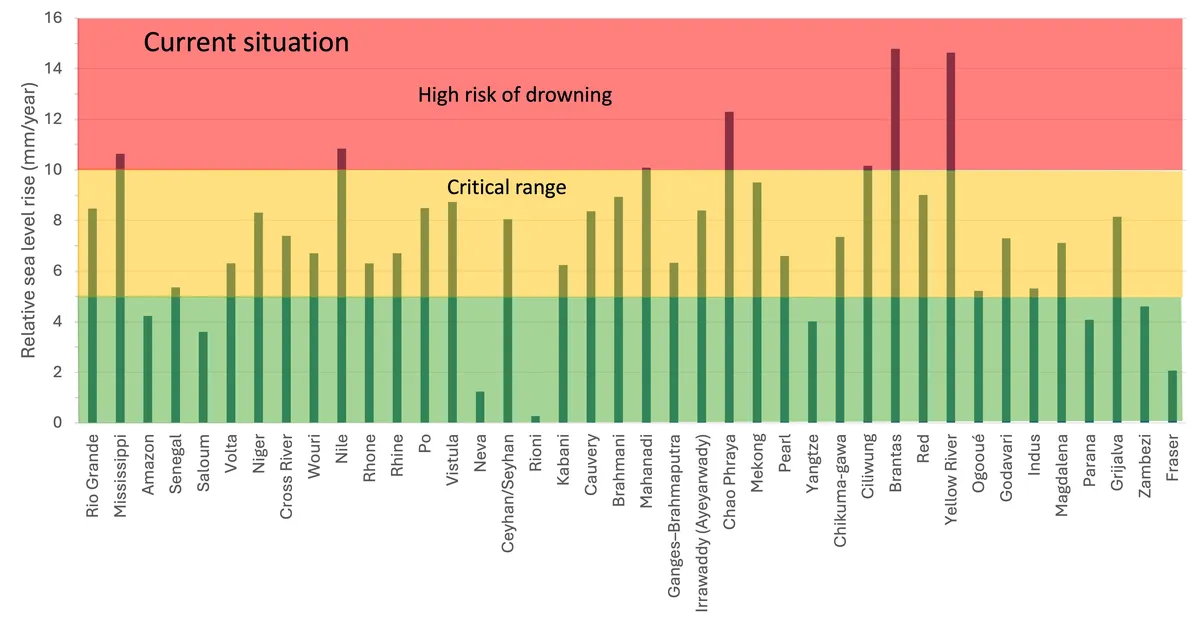
Currently, most of these 40 deltas already entered this critical range when subsidence and absolute sea level rise are added to get the relative sea level rise.
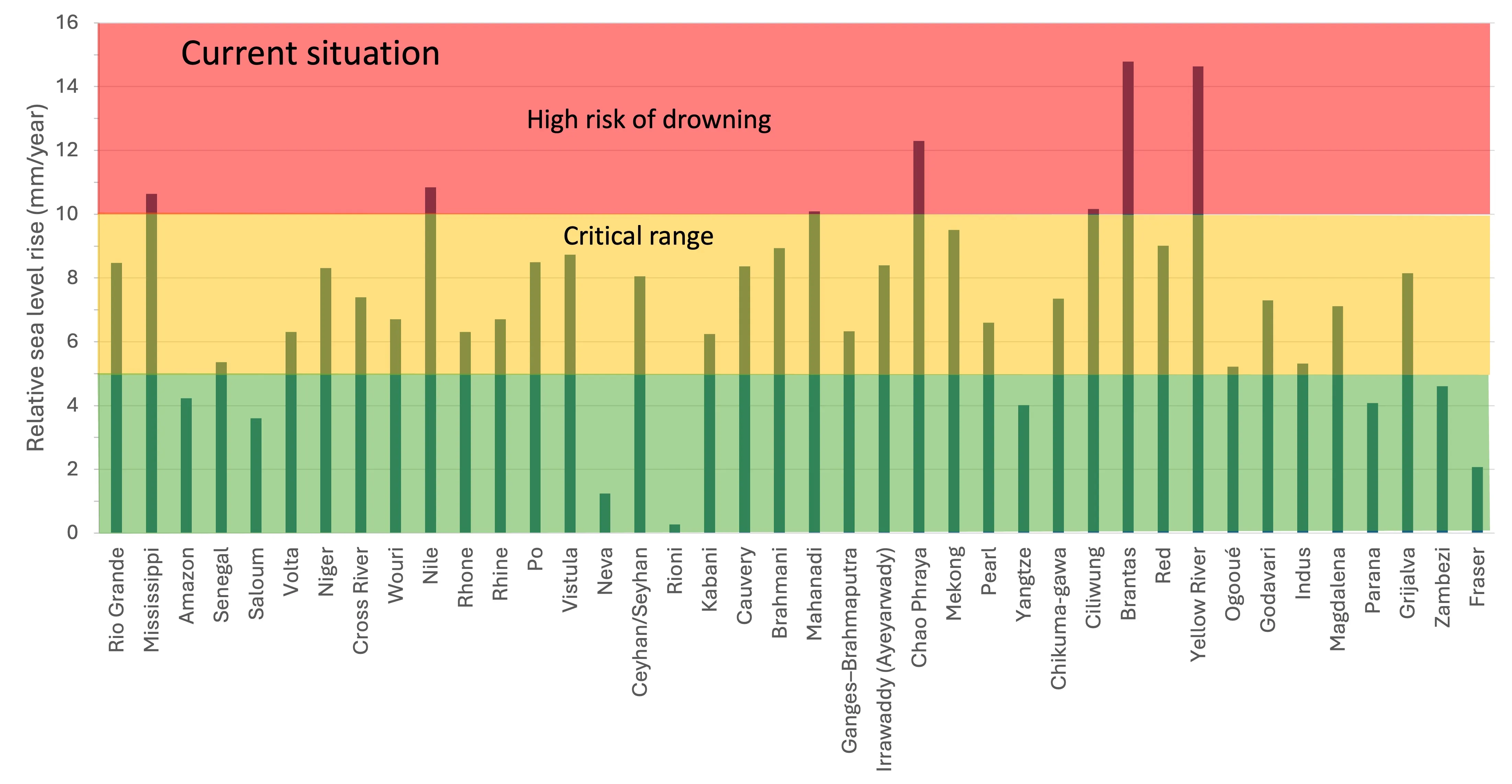
Graph: Current relative sea level rise for 40 major river deltas globally. Data from: Ohensen et al. (2026). Modified by including colours green, orange and red indicating ‘likely safe’, ‘critical range’ and ‘high risk of drowning’, respectively (under Creative Commons license 4.0).
When we plot the rate of absolute sea level rise against the rate of subsidence for the current situation, we see that subsidence is an important factor contributing to reaching the critical range of 5–10 mm/year – the orange zone in the graph. The graph illustrates that “addressing the drivers of subsidence is an effective way to reduce the vulnerability of deltas to flooding and salinisation”.
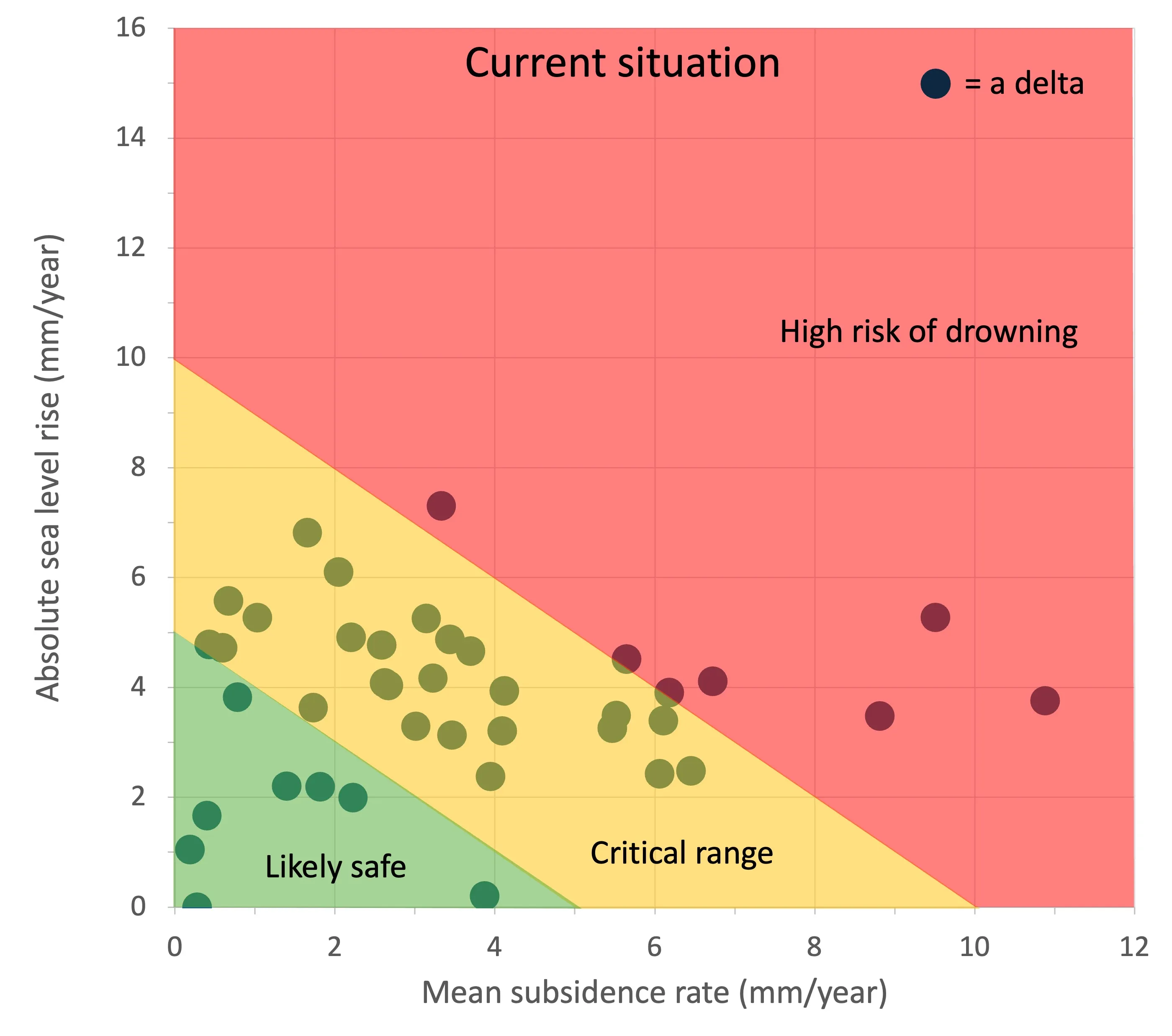
Graph: Current absolute sea level rise and mean subsidence rate for 40 major river deltas globally. Data from: Ohensen et al. (2026). Modified by including colours green, orange and red indicating ‘likely safe’, ‘critical range’ and ‘high risk of drowning’, respectively (under Creative Commons license 4.0).
A bleak future
There is a caveat to this conclusion, however. In the second half of this century, sea level rise will accelerate to a rate that exceeds subsidence by far. At that point, addressing subsidence will hardly reduce the risk of drowning deltas and low-lying coastal areas. In the graphs below, the projections of absolute sea level rise for these environments are shown for 2050 and 2100 – taken from this Nature study. The future subsidence rate is assumed to be equal to the current situation. Clearly, reducing or even halting subsidence will no longer ‘push’ these environments out of the danger zone.
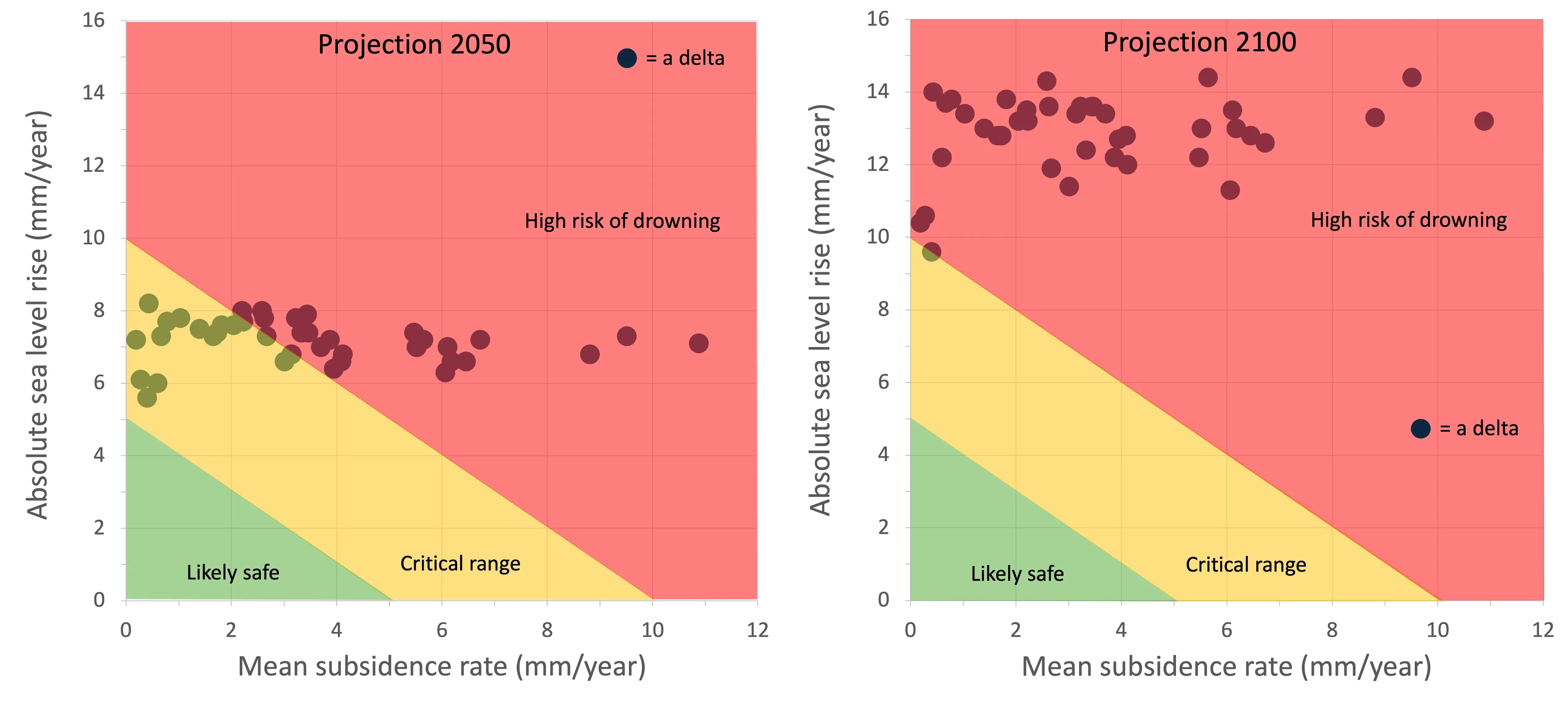
Graph: Projections of absolute sea level rise in 2050 (left) and 2100 (right) and current mean subsidence rate for 40 major river deltas globally. Data from: Ohensen et al. (2026). Modified by including colours green, orange and red indicating ‘likely safe’, ‘critical range’ and ‘high risk of drowning’, respectively (under Creative Commons license 4.0).
Disturbed sediment supply
The recent Nature study is a wake-up call. The data from this study not only confirms the results of previous studies that absolute sea level rise is the dominant driver that will determine the future of our deltas and low-lying coastal areas. The data also indicate that the future of these environments looks bleak without adequate protection against erosion and flooding, and that the first signs of drowning are not far away. In addition, these results highlight the importance of addressing the disturbed sediment supply to these environments due to human interventions in many rivers worldwide.