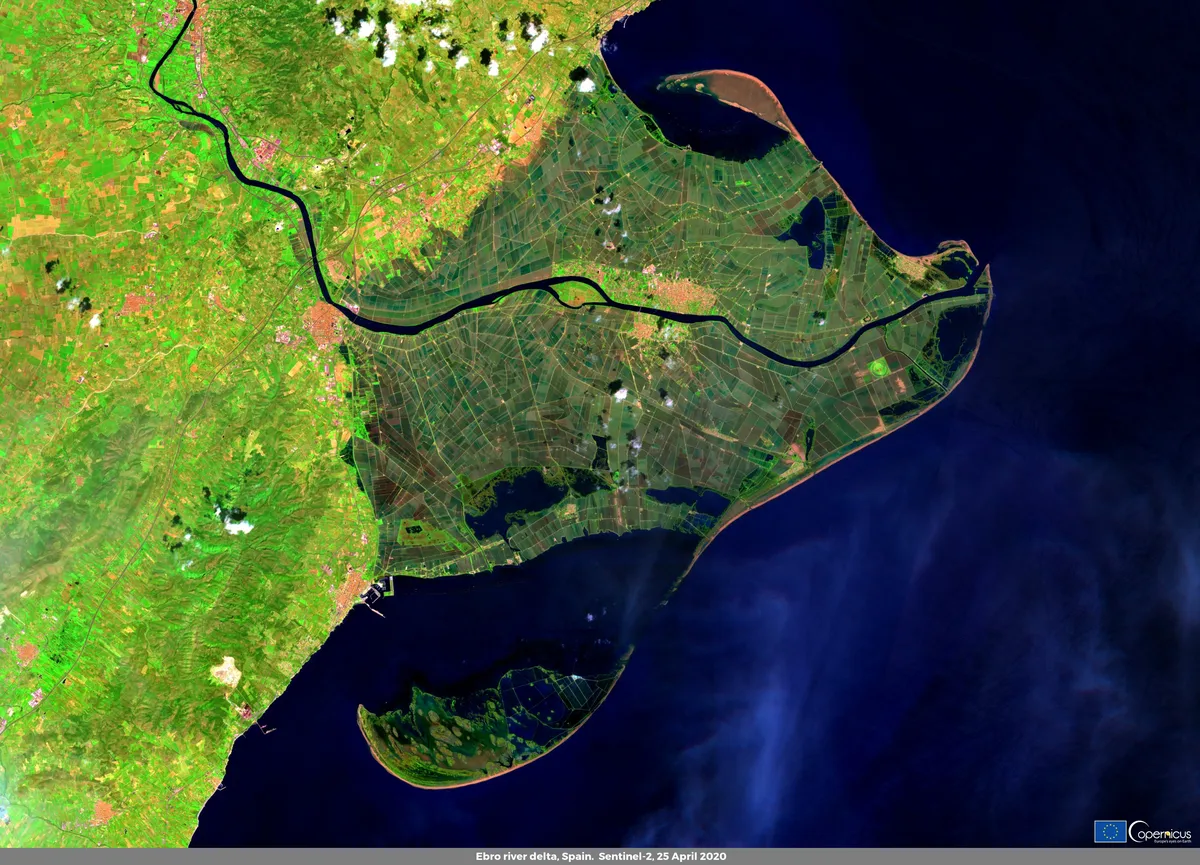
Photo: Ebro river delta, Spain. Credit: European Union, Copernicus Sentinel-2 imagery.
River deltas are home to about 5% of the global population, yet these deltas occupy only 1% of global land area. Due to their often high population density and low elevation, they are very vulnerable to rising sea levels. Their vulnerability is determined not only by absolute sea-level rise, but also by vertical land movement. The sum of both determines relative sea-level rise: the rise of the level of the sea relative to elevation of the land. Many deltas are subsiding for various reasons. As a result, relative sea-level rise in deltas is often much greater than the sea-level rise itself.
Subsidence is dominant
Delta subsidence and relative sea-level rise have been quantified over the period 2014-2023 from satellite data across 40 major river deltas globally, spanning five continents. The results show that subsidence contributes more to relative sea-level rise than absolute sea-level rise itself for most deltas over the twenty-first century. Subsidence dominates sea-level rise.
Subsidence rates
More than half of these deltas are experiencing land subsidence of more than 3 mm per year. In 13 of them, the average land subsidence exceeds the current global sea-level rise of about 4 mm per year. Only in 12 of them, the average land subsidence is relatively low at 2 mm per year or less.
In all but two deltas, more than half of the delta area is sinking. In almost half of the deltas more than 90% of the delta area is sinking. In some of these deltas, more than half of the delta area is sinking faster than 5 mm per year. These most vulnerable deltas are generally located in Asia.
From this analysis of 40 deltas, the authors of this study conclude that about half of the global delta areas are sinking.
Drivers of subsidence
These high subsidence rates are man-made. The main driver is excessive groundwater extraction. Sediment flux deficits due to dams and levees, and urbanization are also important drivers of subsidence. The authors did not consider the effects of natural sediment compaction and tectonics, oil and gas extraction, and peat drainage. These latter factors were considered less important causes of subsidence.
The authors of the study concluded that addressing the drivers of subsidence is an effective way to reduce the vulnerability of deltas to flooding and salinisation.
Source: Ohensen et al., 2026. Nature 649: 894-901.